

Citizens oppose while business, labor groups support
The controversy over data centers in the Northwest Georgia area is one of many happening all over the United States. Citizens in each area have different concerns unique to them but the larger question is how to allocate resources without hurting those living in those areas.
Most of Northwest Georgia remains vacant of data centers with the projects concentrated in Bartow and Floyd Counties.
Bartow County is home to three projects including the Switch facility in Cartersville, the Atlas Development Project in Adairsville, and Project Bunkhouse near Stilesboro. The Atlas project will be a $4.5 billion center and Project Bunkhouse will be one of the largest in Georgia covering 876 acres with a $19 billion price tag.
Floyd County has a Microsoft center on Huffaker Road and an approved center near Coosa High School. Atlas Development is building Project Gracie, a 2.4-million-square foot campus recommended by the planning commission last May and later approved by the Floyd County Board of Commissioners. The $4.7 billion project on 278 acres of land near Vann Road is expected to bring high-end jobs to Rome and surrounding areas once it’s completed in 2032.
Counties without data centers can still feel the impact. Cobb County has no data center proposals but clusters of data centers in Douglasville and Fulton County are expected to affect the regional metro-Atlanta power grid that includes Cobb County.
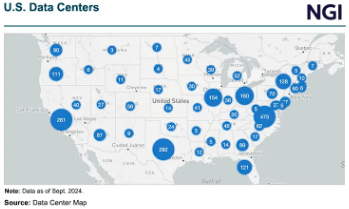
Current data shows 3,900 data centers listed across all 50 states with large centers exceeding 150 GW of power needs planned for 24 states. Virginia leads the country with more than 600 operational data centers. Texas has 400 operational and 400 planned with most around the Dallas-Fort Worth area. California has 300 to 600 operational data centers with the majority in Silicon Valley.
Georgia has between 160 to 200 operational data centers with 295 planned. Illinois, Pennsylvania, and Arizona have hundreds operational and planned. Oregon is becoming a key secondary market with Ohio, New York, Florida, and North Carolina following.
Louisiana approved a Meta $10 billion data center project to accommodate its AI. Wyoming also approve a 3GW new capacity center.
Thirty-six states offer tax incentives. Cities across the nation from Pittsburgh to Phoenix are having the same discussions of whether to allow data centers in their areas.
Pennsylvania
Amazon, Microsoft and other companies are eyeing the area because of the area’s natural gas reserves, according to the Pittsburgh Post-Gazette. More than 100 data centers have been proposed for the state. President Donald Trump and Republican Sen. Dave McCormick attended the Energy and Innovation summit in Pittsburgh recently and the Alleghany Conference on Community Development support data center initiatives.
Plans in Plymouth, Conshohocken, Springdale and Steelton have mixed reactions from the public. Areas were hit hard when steel mills closed so business investment is wanted but many are protesting data centers because of the impact.
The biggest concern in Pennsylvania isn’t water use, as rivers are abundant. It’s noise, power grid reliability, and land use. The Conshohocken proposal was pulled after residents came to oppose it at a meeting. Steelton, dramatically affected by steel industry closings, has old industrial properties. Citizens want a voice in their future use. Some feel it would be better to convert them into residential and commercial properties rather than data centers. Others rather see a data center on industrial properties than take up farmland.
Ohio
Wilmington, Ohio residents are fighting a proposed Amazon data center with the Wilmington Residents for Responsible Development holding opposition meetings. Concerns include location, environment, jobs, and health impact.
The Wilmington Planning Commission tabled the project in January after developers failed to answer specific questions, according to local news reports.
Residents in Maysville and Hamilton are also forming opposition groups for proposals in their areas.
Arizona
Residents are vehemently opposing a proposed data center called Project Blue in Tucson, delaying a final decision to months down the road. The big concern is water. Tucson is a desert and water is a precious commodity.
Project Blue, proposed for Pima County land, would use 870 acres-feet annually once it is completed, according to the City of Tucson drafted plan. City officials equate that to yearly water use of two Pima County 18-hole golf courses.
Beale Infrastructure, which is the Project Blue Developer, said it will use $100 million to build an 18-mile pipeline of reclaimed water. It also promises for the pipeline to be large so the city can use it for other projects, according to local media.
One local union is supportive. Project Blue could result in $3.6 billion in economic development with 3,000 construction jobs and full-time positions at the facility.
Power Grid Concerns
The biggest issue for most residents is how data centers will affect an already overstretched power grid. Statistics from 2023 show data centers already operations used 4% of all U.S. electricity. It is expected to jump to 6 to 12% by 2030, according to Conimby.org.
A solution could present more problems and more controversy. Mini nuclear sites, also called micro-nuclear reactors or small modular reactors (SMRs) are being built to generate more power to meet data centers needs. They have a small footprint but generate between 1 to 50 megawatts of power.
Terra Praxis is a leader on these types of projects with Microsoft as its primary client. SMRs also have Trump’s support. He signed four executive orders in 2025 to speed up their construction and make getting licenses easier.
Other names in this industry are NuScale Power and AWS. AWS bought a hyperscale data center campus that is connection to Susquehanna Nuclear Station in 2024. The $650 million deal with Talen Energy, owner of both the data center and the nuclear plant, is the first to pivot data center power needs to nuclear energy.
Building mini nuclear sites will likely cause even more controversy than data center construction as they will be placed in areas with more and larger data centers. Currently, top states for these facilities are Texas, Utah, and Wyoming.
Other concerns:
- Grid stability. Outages could wipe out power for regions.
- Erratic volt spikes that can cause home and commercial fires and damage household appliances. Studies show that 75% of those within 50 miles of data centers have distorted power readings
- Health concerns caused by fine particulates from diesel backup generators and chemically treated water, unsafe for drinking or farming, ending up in the water supply.
- Excess water use causing wells to dry up.

Melody Dareing is a freelance writer for publications in the U.S, Canada, the UK and Germany. She is a former news director of Adelphia Channel 4 and WBHF Radio. She is on Facebook, X, YouTube, content on Substack, and has a podcast on Rumble.